Most people who reach out to us about a room don't start with a spec sheet. They start with a feeling. The room is "echoey." Calls are "terrible." The restaurant gets "too loud when it fills up." The studio "doesn't sound right but I can't say why." The living room "swallows the bass" or "makes everything harsh."
These are real observations. They're accurate. But they're not specific enough to act on, and that's the gap where most people get stuck. The room feels wrong, but the next step isn't obvious. Should you buy panels? Move furniture? Call a consultant? Rip out the ceiling? Do nothing and accept it?
The Acoustic Score exists to close that gap. Not to answer every question, but to make the first question answerable.
What a score actually does
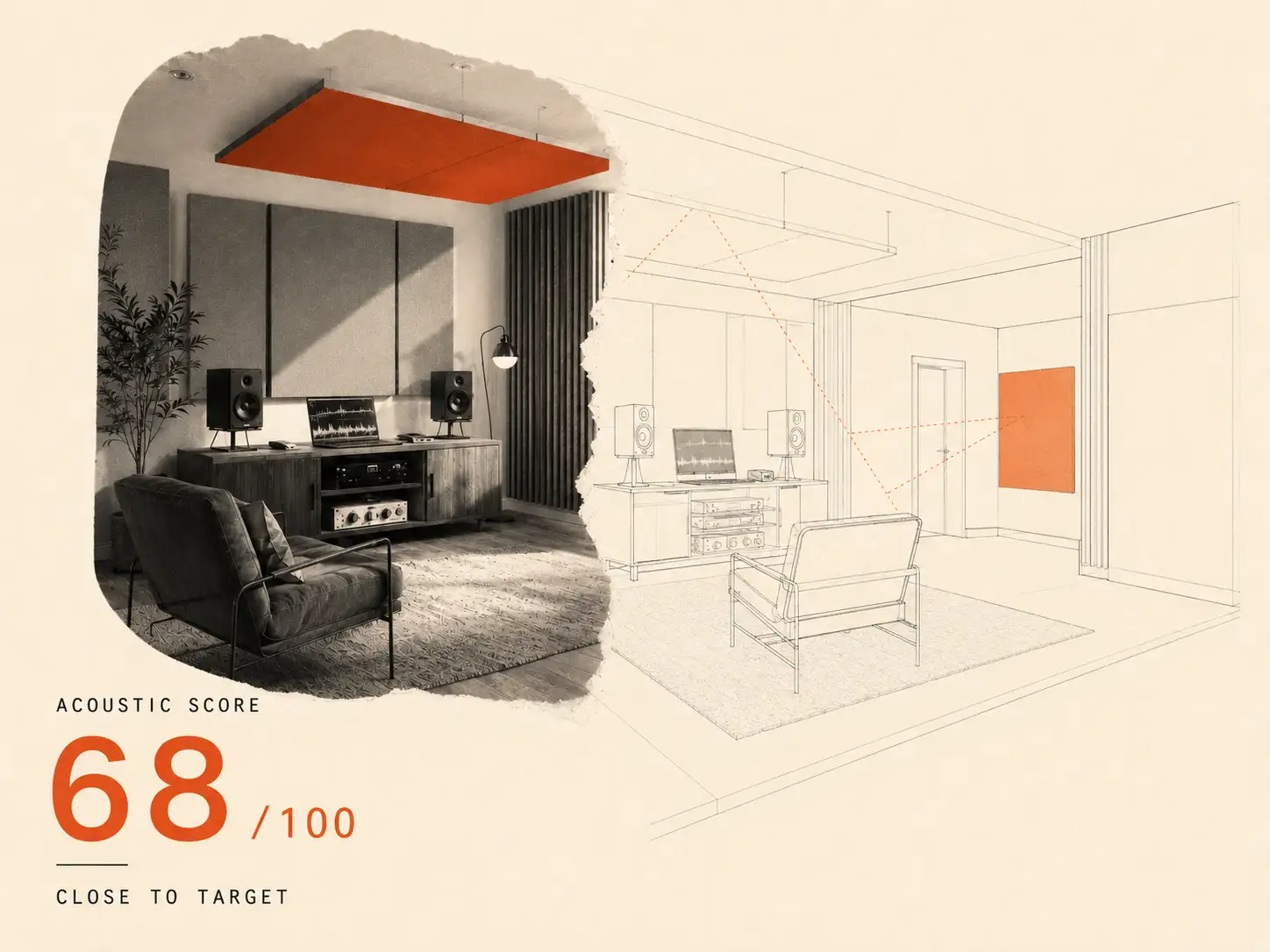
The Acoustic Score takes the information you already have (room dimensions, surface materials, ceiling type, use pattern, furniture density, the problems you're noticing) and runs it through treatment logic. Not a full simulation. Not a measurement. A structured reading of your room's likely acoustic behaviour based on what matters most.
The result is a profile. And a good profile does several things at once.
It tells you whether the room's surfaces are working for or against you. A room with a hard ceiling, hard floors, and glass walls has a fundamentally different acoustic character than a room with carpet, curtains, and upholstered furniture, even if they're the same size and shape. The score maps where you sit on that spectrum. Not with a single number, but with enough resolution to see which surfaces are contributing most to the problem.
It tells you how reverberant the room is likely to be. Reverberation time, how long sound takes to decay, is the single most useful indicator of a room's acoustic personality. Too long, and speech loses clarity, music gets muddy, and the space feels tiring. Too short, and the room feels dead, uncomfortable, and strangely intimate. A score can estimate where your room lands and whether the decay is likely to be even across the frequency range or skewed toward the bass or treble.
It tells you where treatment will have the most impact. This is the part people find most useful. Not just "you need treatment", but "the ceiling is your biggest opportunity" or "the side walls are creating early reflections at the listening position" or "the room is under-damped in the low-mid range." That kind of directional insight turns a vague problem into a clear first move.
And it tells you how serious the situation probably is. Some rooms need a single well-placed ceiling panel and they're transformed. Others have deep structural issues (parallel hard surfaces, problematic proportions, massive glass facades) that need more considered intervention. Knowing which category your room falls into before you spend anything is genuinely valuable.
What a score doesn't do, and why that's fine
The Acoustic Score is triage. Good triage. The kind that saves you from guessing, from overspending, and from treating the wrong surface first. But it's not a full diagnosis, and it's worth understanding where the boundary is. Not because the score is flawed, but because knowing what comes next makes the whole process feel clearer.
A score doesn't measure. It estimates. There's an important difference. A measurement involves microphones, test signals, and a physical reading of what the room is actually doing at specific positions. An estimate uses known acoustic relationships (surface absorption coefficients, room volume, expected modal behaviour) to predict what a measurement would likely show. For most rooms, the estimate is remarkably close. But for rooms with unusual geometry, mixed-height ceilings, open-plan connections to adjacent spaces, or complex low-frequency issues, the prediction can only take you so far.
A score doesn't resolve every frequency. Bass behaviour in particular is geometry-dependent in ways that a score can flag but not fully map. Room modes, the standing waves that cause bass to boom in one corner and vanish in another, are determined by the exact room dimensions, the speaker position, and the listening position. A score can tell you that your room proportions are likely to create modal problems. Pinpointing exactly which frequencies and exactly where requires measurement.
A score doesn't account for everything in the room. The bookshelf full of irregularly shaped objects that's accidentally acting as a decent diffuser. The heavy curtains that are absorbing more high-frequency energy than you'd expect. The HVAC duct that's creating a resonance at 160 Hz. Real rooms are messy, and a score works with the major variables (surfaces, dimensions, materials, use) rather than every object and anomaly in the space.
A score doesn't replace professional judgment for high-stakes rooms. If you're building a recording studio, a broadcast facility, a concert hall, or a medical space with speech privacy requirements, a score is a useful conversation starter but not a specification tool. Those rooms need measurement, modelling, and professional acoustic design. The score helps you understand the landscape. The specialist helps you build the road.
None of this makes the score less useful. It makes it appropriately useful. The value of a good first reading is that it tells you clearly what the room needs in broad terms, where to focus first, and, critically, whether you can act on general guidance or whether you need to go deeper.
Why the first step matters more than people think
Here's something we've noticed over years of working on rooms: the quality of the first step determines the quality of everything that follows.
When someone starts with a clear picture of their room, even an approximate one, they make better decisions at every stage. They don't overbuy treatment for a room that only needed a ceiling cloud. They don't underbuy for a room that has serious reflection problems. They don't put absorbers on the wrong wall. They don't spend €2,000 on bass traps when the actual issue is mid-frequency flutter echo from two parallel plaster walls.
A score gives you that picture. It's the difference between walking into a hardware store saying "my room sounds bad, what do you have" and walking in saying "I have a 40-square-metre room with 0.7 seconds of reverberation time, primarily driven by an untreated hard ceiling, and I need about 8 square metres of broadband absorption focused on the ceiling and first reflection points." One of those conversations ends with the right treatment. The other ends with a guess.
And for a lot of rooms, maybe most rooms, the score and the guidance that comes with it is genuinely enough. A well-placed ceiling panel, some strategic absorption at key reflection points, maybe a corner treatment for bass control. Clear instructions, sensible priorities, real improvement. Done.
When to go further
The score is designed to make this decision easy. If your room is straightforward (regular geometry, clear surfaces, a well-defined use pattern) the score gives you what you need to act. Treatment logic, placement guidance, material direction, expected improvement.
If the room is more complex (unusual shape, mixed use, significant low-frequency concerns, compliance requirements, a design context where every intervention needs to be carefully considered) the score tells you that too. Not as a dead end, but as a clear signpost: this room would benefit from a deeper acoustic reading.
That deeper reading is what we call a Remote Scan. A guided thirty minute session, then a report within forty-eight hours: your room calculated from its geometry and materials, a frequency-by-frequency picture of how it behaves today, a prioritised treatment plan, and a clear price. It is still a calculation rather than a measurement. When a room genuinely needs microphones on stands, that is an on-site Field Spec, and we say so.
The score gets you oriented. The Remote Scan gets you specified. Both have a job, and neither is trying to do the other's work.
The real principle
Every room is legible if you know how to read it. The surfaces, the proportions, the materials, the way sound behaves when it hits them: all of that tells a story. The Acoustic Score is the fastest way to start reading that story.
It won't give you every chapter. It doesn't need to. What it gives you is the beginning: a structured, honest picture of what the room is doing and what would help it most. For a lot of people, that's the thing that was missing. Not more products. Not more opinions. Just a clear starting point.
That's what a good score does. It makes the room legible. Everything after that gets easier.