You know that moment. It's Saturday, 11 a.m., every table is taken, the queue is four deep, the grinder is running, the steam wand is screaming, someone's calling out an oat flat white, and the whole room suddenly tips from "buzzing" into "chaotic." Your staff start shouting across the bar. Customers lean in to repeat their orders. The music, which sounded great twenty minutes ago, disappears under a wall of noise that seems louder than the sum of its parts.
And then by 2 p.m. it's half-empty again and the room feels completely different. Calm. Warm. The way you designed it to feel.
If you run a café, you've lived this. And you've probably assumed it's just what happens when a small space fills up with people. More people, more noise. That's physics, right?
Sort of. But not the way you think.
A busy room and a loud room aren't the same thing
Here's something worth sitting with for a second. Think of a café you've been to that felt great even when it was packed. Not quiet. Nobody wants a quiet café. But somehow it held together. Conversations stayed at the table. You could hear your friend without raising your voice. The espresso machine did its thing in the background without swallowing everything else. The room felt alive but not aggressive.
Now think of a room that falls apart at half that capacity. Where eight people make it feel like twenty. Where the staff start projecting by 10 a.m. and by noon everyone is essentially yelling at a normal distance.
Same city. Similar size. Similar crowd. Completely different experience. The difference isn't the people or the service or the playlist. It's the room.
What's happening in that second space is something acoustic engineers call stacking, though you don't need the jargon to understand it. Every sound in a café (the grinder, the steam, the conversation at table four, the chair scraping, the cup hitting the saucer, the barista calling an order) sends energy into the room. In a forgiving space, that energy gets absorbed relatively quickly. Each sound has its moment, then fades. The next one arrives into relative clarity.
In a reflective space (and most cafés are reflective, because tile and concrete and exposed brick and metal and glass are beautiful but acoustically hard) those sounds don't fade fast enough. They bounce. Off the counter, off the back wall, off the ceiling, off the window. Each reflection is a little copy of the original sound, arriving a few milliseconds late, overlapping with the next sound that's already on its way. The room starts layering copies of itself on top of itself.
That's the multiplier effect. The room isn't just full of activity. It's amplifying activity. Ten people's worth of sound starts behaving like twenty. Your staff raise their voices to be heard over reflections of their own voices from three seconds ago. Customers speak louder to cut through the haze. The music gets turned up because it's being drowned out. Everything escalates, and nobody did anything wrong.
The espresso machine didn't get louder. The room did.
This is the bit that changes how you think about it. Your equipment doesn't change between 9 a.m. and 11 a.m. The grinder is the same grinder. The steam wand is the same steam wand. But at 9 a.m. with five people in the room, there's enough acoustic headroom for the room to absorb those sounds between bursts. At 11 a.m. with thirty people, every hard surface is already loaded with reflected speech energy, and now the grinder and the steam wand are landing on top of a room that's already saturated.
It's like the difference between dropping a stone into a still pond and dropping it into a pond that's already choppy. Same stone. Very different splash.
The steam wand is a great example because it's one of the brightest, most cutting sounds in any café: high-frequency energy that bounces hard off flat surfaces and carries across the room. In a treated space, that burst hits the ceiling, gets absorbed, and it's done. In an untreated space, it ricochets around for a quarter of a second, overlapping with the next burst, and suddenly the whole room feels like it's centred on the machine even when you're sitting six metres away.
Your customers don't think about any of this consciously. They just feel it. The room feels "hectic." They finish their coffee a little faster. They don't settle in for a second one. They come back on a Tuesday when it's quieter but skip Saturday because "it gets too crazy." And you lose the exact trading hours that should be your best.
What the good rooms have figured out
The cafés that stay composed at full capacity aren't doing anything radical. They've just made sure the room absorbs enough energy to keep up with the activity inside it.
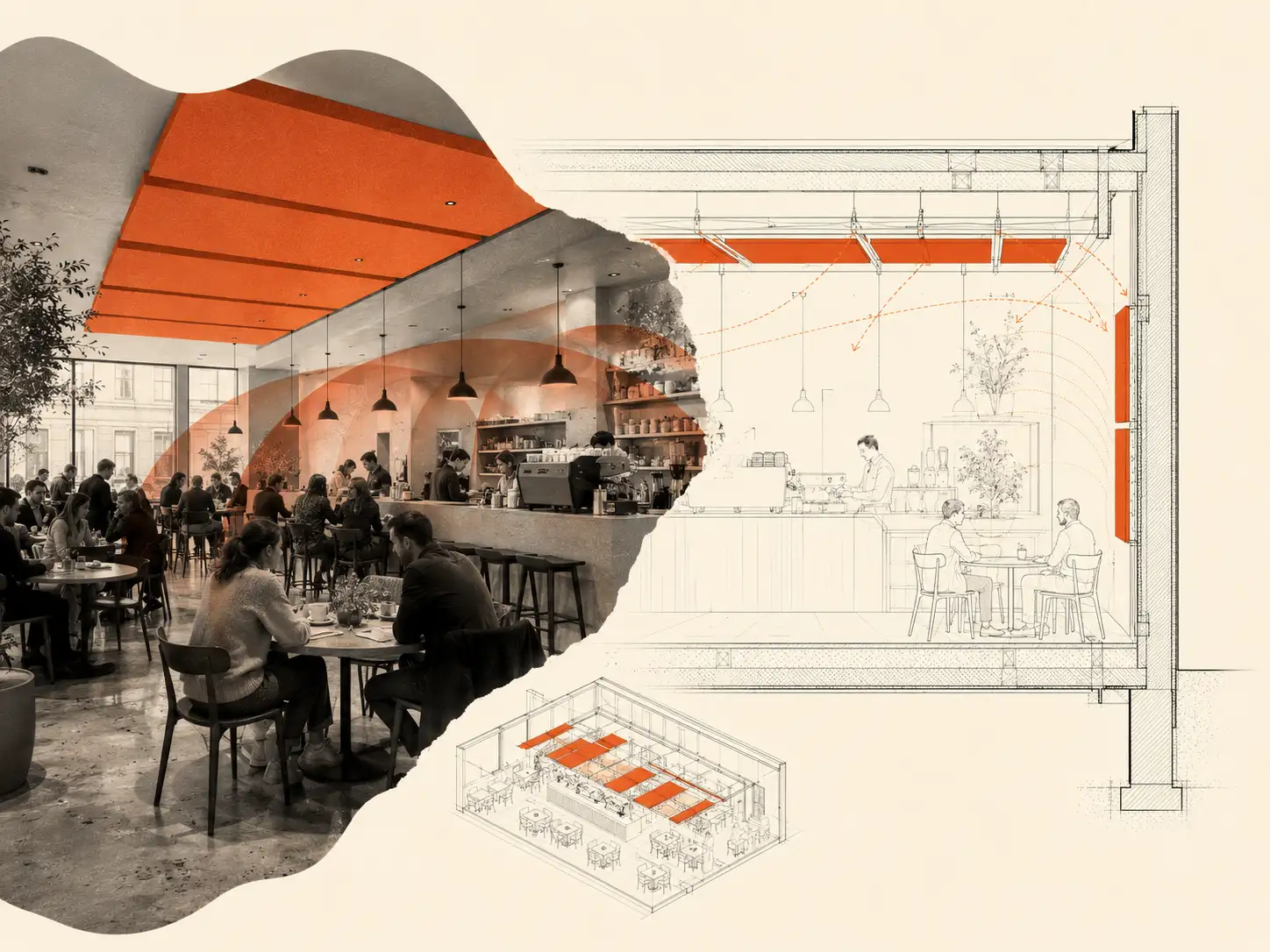
Usually it starts with the ceiling. In most café spaces, the ceiling is the largest single surface and the one doing the most acoustic damage, because sound rises, hits a hard ceiling, and comes straight back down onto the tables. A ceiling that absorbs instead of reflects can change the entire character of the room. Not by making it quiet. By making it clear. Conversations stay closer to the table. Equipment noise decays faster. The background level drops enough that nobody needs to raise their voice, which means the overall volume stays proportionate to the actual number of people in the room.
After the ceiling, it's usually the wall surfaces closest to the service area: the zone where the loudest activity is concentrated. Shortening the decay time right around the bar, the grinder, and the queue area keeps that energy from radiating across the whole room. The barista can call an order at a normal volume. The customer can hear it. Nobody's shouting.
And then there are the subtler moves. A fabric-wrapped panel on the back wall that reads as interior design, not as treatment. An upholstered banquette that's doing double duty as seating and absorption. A ceiling detail that looks like an architectural choice but is quietly handling 40% of the room's acoustic problem.
The point, and this is the part we think about a lot, is that none of this should look like acoustic treatment. It should look like your café. It should feel like the room was always this considered. The best compliment we ever get on a hospitality project isn't "great acoustics." It's "this place just feels good." Because that means the treatment is doing its job without anyone noticing it's there.
The Saturday test
Here's a simple experiment. Next Saturday at peak hour, stand behind the bar for a minute and just listen. Not to any particular conversation. Just to the room. Listen to how long sounds hang in the air after they happen. Listen to whether you can distinguish individual voices at the nearest table or whether everything blurs into a wash. Listen to whether your staff are speaking or projecting.
Then do the same thing on a quiet Tuesday morning. Notice the difference. Not in volume, but in clarity. That gap between Tuesday's clarity and Saturday's blur is your room's acoustic contribution. It's not the crowd making the mess. It's the crowd plus every reflection the room adds to it.
That gap is also, roughly speaking, the improvement that's available. Not turning Saturday into Tuesday. Nobody wants that. But turning Saturday from chaotic into lively. From "I can't hear myself think" into "this place is buzzing." Same energy. Same crowd. But the room is working with them instead of against them.
Why this is actually good news
Everything we just described is fixable. Not theoretically. Practically. The surfaces that cause the problem are known. The treatment that solves it is well understood. The visual impact can be zero if the room is designed thoughtfully, or it can be positive, because good acoustic elements, specified with care for the space, often improve the look of a room as much as the sound.
And the investment tends to pay for itself in ways that are hard to put a number on but easy to feel. Longer dwell times. More comfortable peak hours. Staff who don't go home with sore throats. Customers who associate your space with warmth rather than volume. A room that holds its character whether there are five people in it or fifty.
Most café owners we work with say the same thing afterward: "I didn't realise how much the room was doing until it stopped." Which is maybe the best way to think about it. The room has been adding something to every peak hour that nobody asked for. All you're really doing is letting it stop.