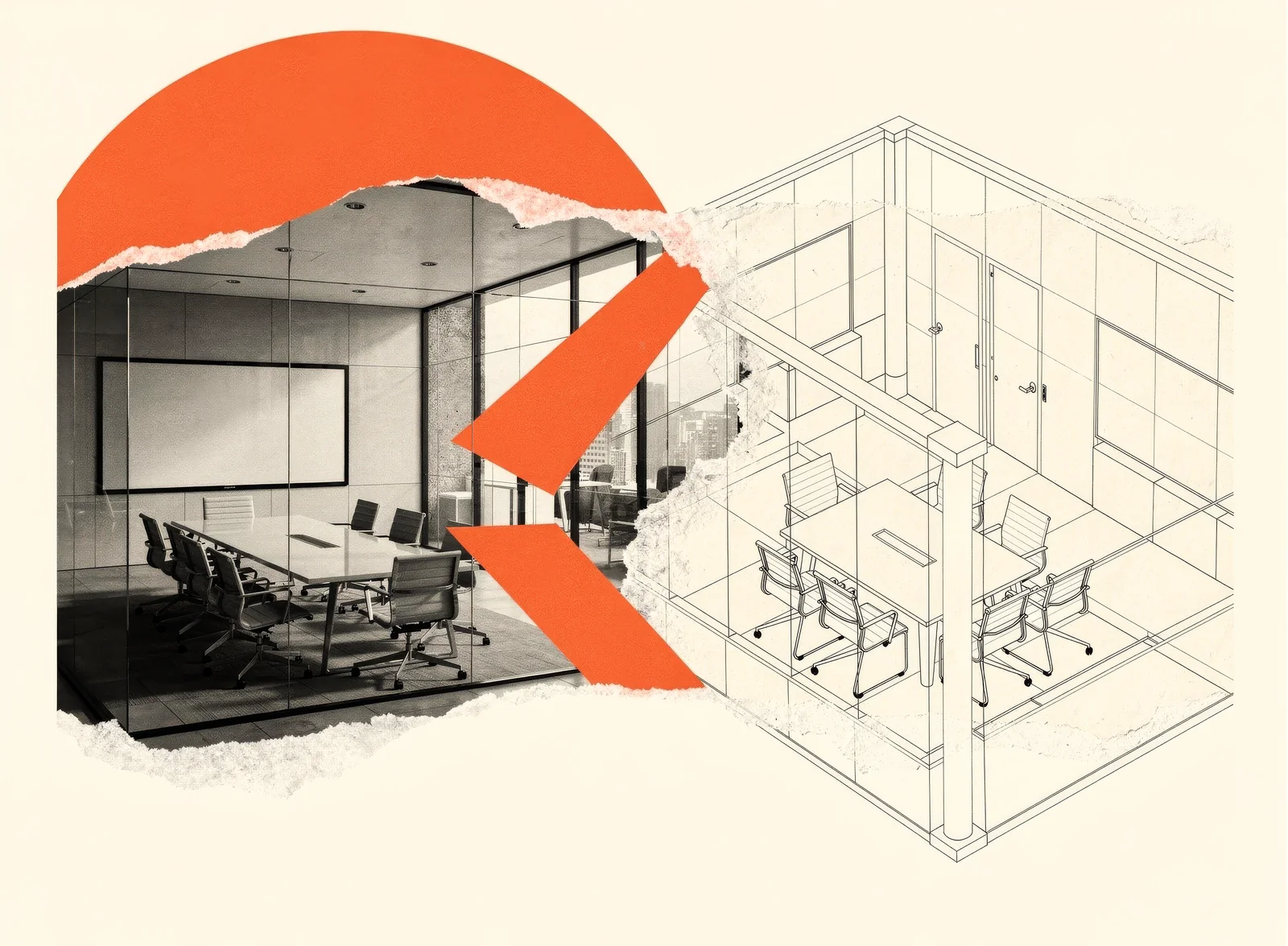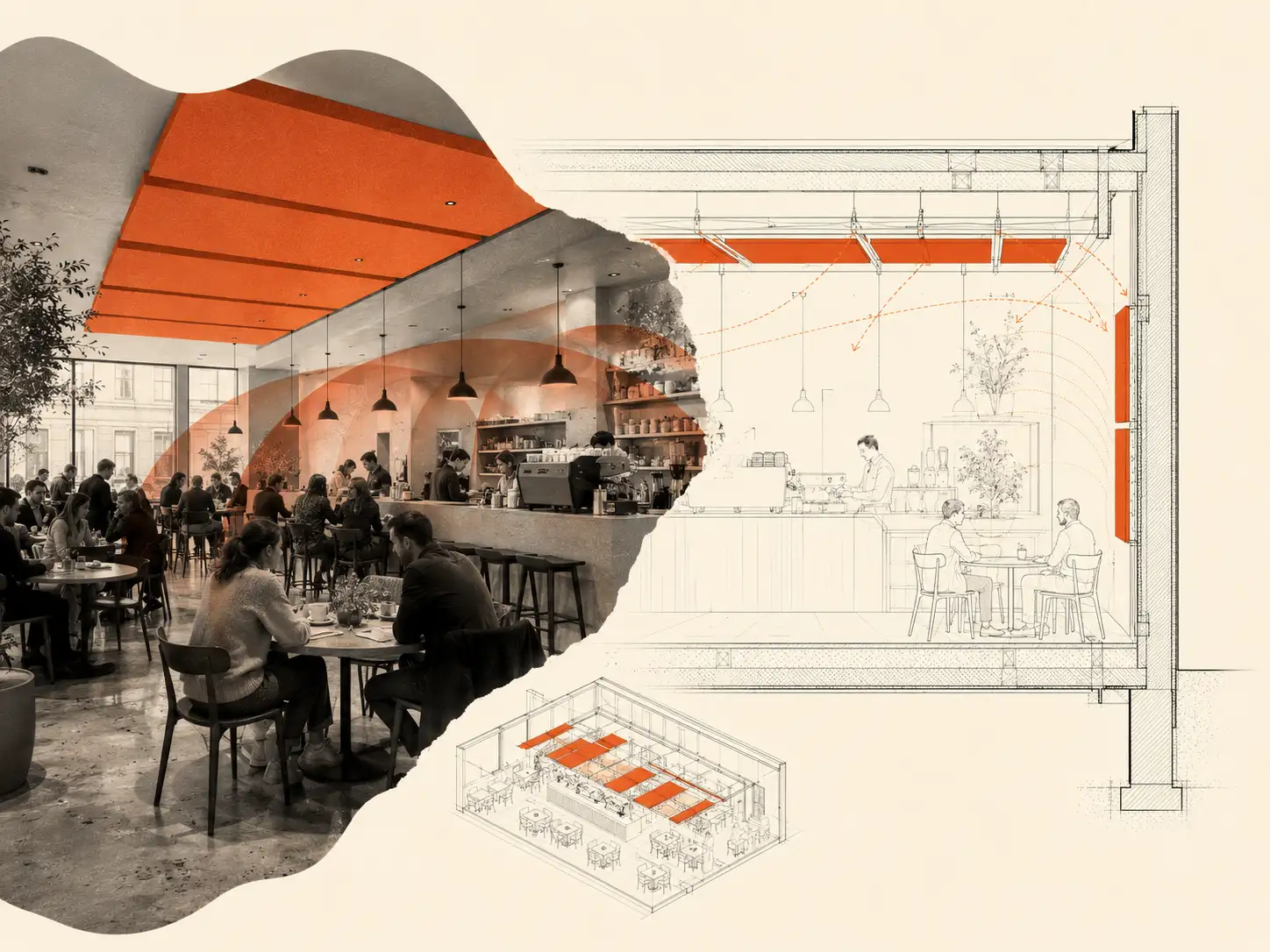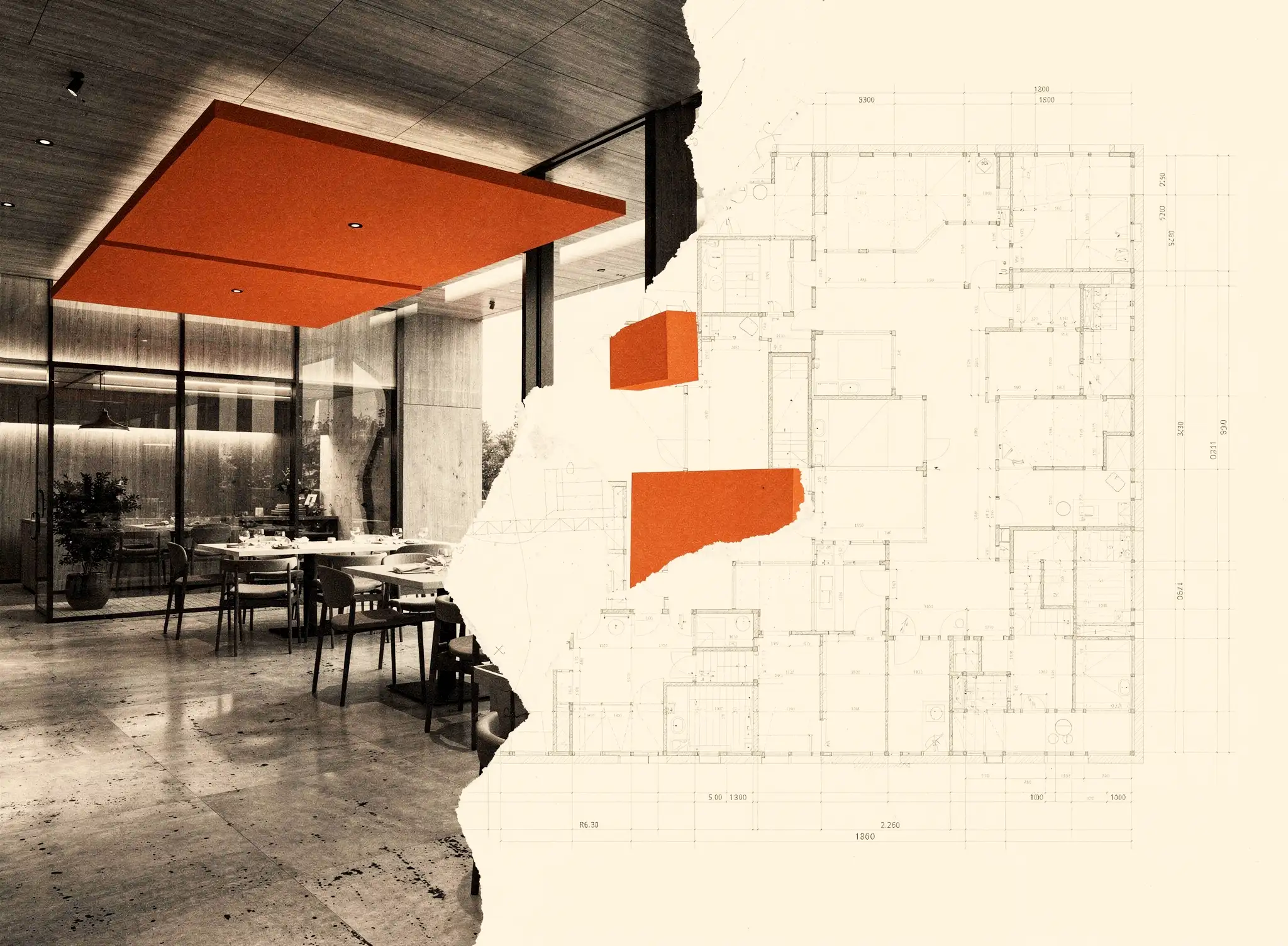
We see it constantly. A project is nearly finished (beautiful materials, considered lighting, good furniture, strong spatial concept) and then someone raises the question of acoustics. Maybe a client complained during a soft opening. Maybe the contractor noticed the reverberation during final walkthrough. Maybe the architect always knew it would be an issue but kept pushing it down the list because there were bigger fires.
Either way, by the time the call comes in, the ceiling is done, the walls are specified, the hero surfaces are locked, and the budget has been spent twice over. Now acoustics has to enter a room that never made space for it.
This is when treatment starts to feel like punishment. And honestly, that feeling isn't wrong. It's just misplaced. The problem isn't that acoustic treatment is inherently ugly or disruptive. The problem is that when it arrives at the end, it has to fight the room instead of belonging to it.
Why it keeps happening
There's no mystery here. Acoustic treatment gets left until the end because it doesn't have an obvious seat at the table during concept and schematic design.
Lighting has a consultant from day one. MEP is in the room early. Furniture gets mood boards and spec sheets. Acoustics? Acoustics sits in a grey zone between building physics and interior design that neither discipline fully claims during the design phases that matter most. The structural engineer thinks about it in terms of flanking transmission between units. The architect thinks about it in terms of ceiling finishes they haven't chosen yet. The interior designer assumes someone else is handling it. Nobody's wrong exactly. It's just a gap.
And then there's the language problem. Acoustic treatment often arrives speaking the wrong dialect. Data sheets. Absorption coefficients. NRC ratings. Sabine calculations. All useful, all necessary, but none of it maps directly onto the way a design team talks about a room. When someone shows you a spec sheet for a 50mm polyester absorber and asks where it should go, that's not a design conversation. That's a retrofit negotiation.
The result is predictable: treatment gets perceived as the thing that has to go on top of the design rather than inside it. And the later it arrives, the more true that perception becomes, because by then, that's literally what's happening.
What "too late" actually costs
Let's be specific about what changes when acoustics enters after the key design decisions are made.
The ceiling is already closed. In most interior projects, the ceiling is the single most effective surface for acoustic treatment. It's the largest uninterrupted area, it addresses both horizontal and vertical reflections, and it has the least visual competition from other elements. But by the time fit-out is approaching completion, the ceiling is typically finished: plasterboard, paint, exposed services, timber slats, whatever the concept called for. Retrofitting absorption into a ceiling that wasn't designed for it means either visually heavy surface-mounted panels, or expensive rework to create cavities that should have been planned from the start.
Wall surfaces are specified and installed. The polished plaster, the timber cladding, the glass partitions, the feature wall: all finished. Any absorption now has to negotiate with surfaces that were chosen for visual and tactile quality, not acoustic performance. The options narrow fast. You end up in conversations about "where can we put panels that won't be seen", which is already the wrong conversation, because it frames treatment as something to hide rather than something to integrate.
The room geometry is fixed. Early in a project, there's often flexibility in room proportions, partition placement, ceiling height zones, and the relationship between hard and soft volumes. All of that matters acoustically. A slightly adjusted room ratio can shift modal behaviour. A dropped ceiling zone over a meeting area can house absorption invisibly. A break in a long hard corridor can interrupt flutter echo paths. By the time construction is done, those geometrical options are gone.
Budget has been allocated. This is the practical killer. Acoustic treatment at the end of a project competes with contingency, snag lists, and FF&E overspend. It's always the thing that feels optional, because the room technically functions without it. People can sit in the chairs, the lights work, the HVAC runs. The fact that speech intelligibility is poor and the room sounds like a swimming pool is uncomfortable but not urgent in the way a broken lift or a fire door is. So treatment gets value-engineered down to whatever's cheapest, which usually means whatever's most visually obvious.
The uncomfortable pattern
Here's what typically happens. The designer, who fought for every material and every detail in the room, now watches someone stick rectangular fabric panels to a wall that was supposed to be clean. Or hang baffles from a ceiling that was supposed to be open. Or scatter standalone absorber columns around a floor plan that was supposed to breathe.
It works acoustically. Kind of. Enough to take the edge off. But it doesn't feel like the room anymore. And the designer is right to be frustrated, because this isn't what good treatment looks like. It's what late treatment looks like. There's a difference.
Late treatment is almost always additive. It's surface-mounted. It comes in standard sizes. It has its own visual language that has nothing to do with the project's material palette. It's solving a problem with the only tools left available, and those tools are blunt.
Early treatment is the opposite. It's embedded. It uses the project's own surfaces, cavities, and ceiling strategy. It might be invisible: absorption behind perforated panels, inside a ceiling void, within a wall build-up. Or it might be visible but authored: a fabric-wrapped element that reads as an intentional part of the spatial composition, not an afterthought. The acoustic layer, when it's there from the start, doesn't need to announce itself. It just makes the room work.
What actually needs to happen, and when
The fix isn't complicated. It's sequential.
During concept design, the acoustic question should be on the table. Not as a detailed spec. Not as a product selection. Just as a set of simple questions: What are the hard surfaces in this room? Where is speech critical? Where is atmosphere critical? Is the ceiling available? Are there cavities we can use? What's the probable reverberation time going to be with these material choices?
This doesn't require a full acoustic consultant at this stage, though it helps. It requires someone in the room who thinks about how surfaces behave when sound hits them. That's it.
During design development, acoustic treatment should get the same status as lighting: a layer that has spatial extent, material character, and placement logic. Where does absorption go? Where does it not go? What visual language does it speak? If the ceiling is going to be the primary treatment zone, what does that ceiling need to be? If walls are mostly hard, where are the soft interruptions and how do they relate to the room's composition?
This is where things like ceiling zone planning, integrated panel detailing, and material specification happen. And this is where the elegance comes from, because treatment that's designed into the architecture has options that treatment added later simply doesn't.
During technical design and construction, the acoustic layer gets detailed like anything else: fixing systems, interfaces with other trades, tolerances, sequencing. No different from how lighting or joinery gets coordinated.
The difference between this sequence and what usually happens is maybe two or three conversations in the first few weeks of a project. That's it. Two or three conversations that save the entire design from having to absorb, literally, a retrofit that nobody wanted.
What good integration looks like
We're not going to pretend that acoustic treatment is always invisible. Sometimes it's visible, and that's fine. As long as it looks like it belongs.
A fabric-wrapped ceiling cloud in a restaurant can read as a spatial gesture, defining the dining zone and adding warmth to the material palette. A series of wall-mounted panels in an office can become a rhythm element, spaced to match a window module or a lighting grid. A slatted timber screen with absorption behind it can serve as both room divider and acoustic control. A perforated metal ceiling can be both architecturally expressive and acoustically transparent.
None of these are compromises. They're design decisions that happen to solve an acoustic problem. And they're only possible when the acoustic logic was present during the design phase, when the material, the proportion, and the placement could be shaped alongside everything else in the room.
The point isn't to hide every absorber. The point is that the acoustic layer feels authored, proportionate, and native to the room's material language. Not like an apology for forgetting about sound.
Why this matters beyond comfort
There's a harder argument here that we think designers should hear.
A beautifully designed room that sounds terrible creates a kind of cognitive dissonance for the people using it. The space says "quality." The acoustics say "afterthought." And over time, people trust the acoustics more than the visuals, because sound is constant and inescapable in a way that a nice wall finish isn't. You can stop looking at the walls. You can't stop hearing the room.
A restaurant where conversation is exhausting will lose repeat guests, no matter how good the food or the lighting. A meeting room where remote participants can't understand in-person speakers will get a bad reputation within weeks. A hotel lobby that echoes will feel institutional regardless of how much marble and brass went into it.
The acoustic quality of a room is part of its design quality. Not separate from it. Not secondary to it. When it's good, nobody notices. The room just feels right. When it's bad, it undermines everything else.
Designers who bring acoustics in early aren't adding a constraint. They're protecting the rest of their work from being undone by a problem that gets harder and uglier the longer it's ignored.
Our position
We think acoustic treatment belongs in the design conversation, not in the snag list. And we think the best treatment is the kind that feels like it was always part of the room, because it was.
That doesn't mean every project needs a full acoustic consultant from day one. Sometimes it just needs someone who understands what rooms do to sound, what surfaces matter, and where the opportunities are before they close.
If you're an architect or designer working on a space where sound matters (hospitality, workplace, studio, residential, anything where people need to hear, speak, focus, or feel comfortable) the earlier that conversation happens, the more options you have. And the less it costs. And the better it looks.
That's not a sales pitch. That's just how rooms work.