You already know something is off. You've sat through enough meetings in that room to feel it. People repeat themselves. Someone always asks "can you say that again?" on the video call. Conversations that should take twenty minutes take forty. And when you walk out, there's a low-grade fatigue that doesn't match what actually happened. It wasn't a difficult meeting, but it felt like one.
Here's the thing: you're not imagining it. And it's probably not the agenda, the team dynamics, or the video platform. It's the room.
The fact that you've noticed puts you ahead of most people who use that space every day without understanding why it drains them. Most teams blame the technology, the meeting culture, or each other. The room is quieter to notice than the behaviour it causes. But once you see it, the fix is surprisingly straightforward, and you might be the person who makes it happen.
What you're actually hearing
When someone speaks in a room, the sound doesn't just travel from their mouth to your ears. It radiates in every direction, bouncing off every surface. The table, the walls, the ceiling, the glass partition, the whiteboard, the screen. Each of those reflections arrives at your ears a few milliseconds after the direct voice, carrying slightly different timing and tonal information.
In a well-behaved room, those reflections decay quickly and evenly. The direct voice dominates. Speech sounds clear, natural, and effortless to follow. You don't think about the room at all. You just hear the conversation.
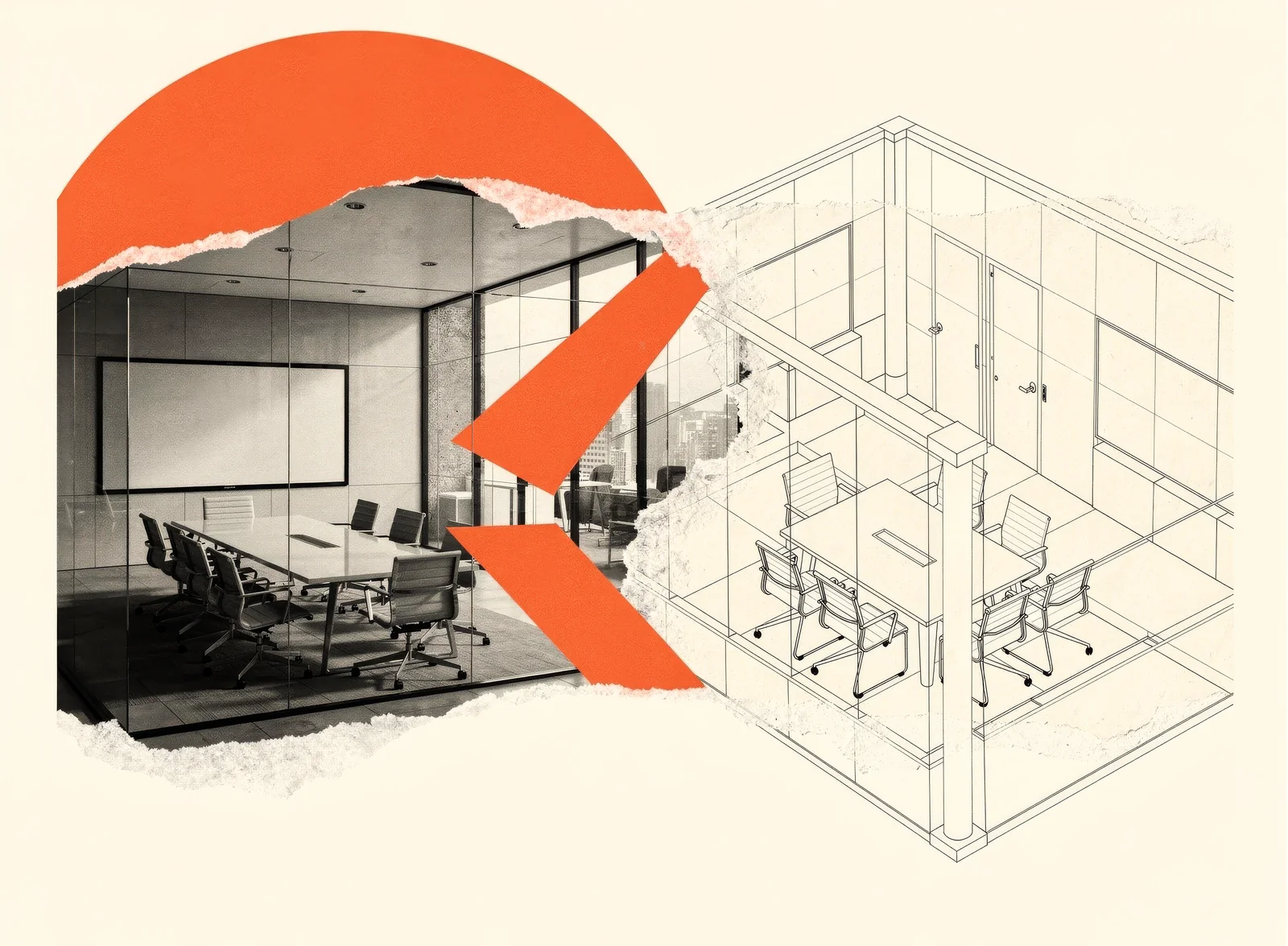
In a reflective room (hard table, bare walls, glass on two sides, untreated ceiling) those reflections don't decay quickly. They pile up. The room keeps talking after the person stops. Every syllable gets a tail of reflected energy that overlaps with the next syllable. Consonants, the parts of speech that carry most of the intelligibility, get masked by the lingering vowel energy bouncing around the room.
Your brain compensates. It works harder to separate the direct voice from the reflected noise. It fills in the consonants it missed. It asks the auditory system to run at higher resolution for longer. And that compensation has a cost: cognitive load. The room is effectively taxing your concentration with every sentence, not because the content is complex but because the acoustic signal is degraded.
That's why you feel tired. Not because the meeting was hard. Because hearing was hard.
The hybrid room problem, and why you probably spotted it there first
If your meeting room has a video conferencing system, you've likely noticed the problem is worse on hybrid calls. There's a reason for that, and it's worth understanding because it makes the case for treatment almost self-evident.
A conference microphone doesn't hear like a human brain. It doesn't have the ability to focus on one voice and suppress reflections the way your auditory system can (even when your auditory system is struggling). The microphone picks up everything: the direct voice, plus every reflection, plus the reverberant tail of the room. It sends all of that down the line to the remote participants, who now hear the room's acoustic problems at full strength with none of the spatial cues that help in-person listeners compensate.
This is why remote participants always seem to have it worse. They do. They're hearing the raw acoustic condition of the room, unfiltered by the brain's spatial processing. And when they speak back, their voice comes out of a loudspeaker that then excites the same reflective room, adding another layer of reflected energy on top.
The result is a feedback loop of degraded intelligibility. In-person participants lean in. Remote participants ask people to repeat. Everyone talks slightly louder to compensate, which makes the room louder, which makes the reflections worse. A meeting that should feel like a conversation starts to feel like a negotiation with the acoustics.
If you've ever thought "our hybrid meetings are terrible but our in-person ones are fine", try sitting in that room alone and clapping once. Listen to how long the sound hangs in the air. That tail is what the microphone hears on every single syllable of every single speaker for the entire meeting. The in-person meetings aren't fine either, by the way. They're just less obviously broken because your brain is doing heroic compensation work that you experience as fatigue rather than as poor audio.
Why nobody has fixed it yet
This isn't a criticism. It's a pattern, and it's almost universal.
Meeting rooms get designed for visual cleanliness. Glass walls for transparency and natural light. Hard surfaces for durability and easy maintenance. Clean ceilings. Minimal clutter. All good design instincts, and all acoustically reflective. The room looks professional and feels professional. The assumption is that good AV equipment will handle the sound.
But AV equipment reproduces sound. It doesn't fix the room the sound is in. A €10,000 conferencing system in a reflective room will faithfully capture and transmit a reflective room. The technology is doing exactly what it's supposed to. The room is the bottleneck.
The other reason nobody has fixed it is simpler: acoustic problems in meeting rooms don't announce themselves. There's no error message. No red light. The room doesn't crash. It just quietly makes everything take more effort, and people attribute that effort to other causes. The meeting ran long because the agenda was too full. The call was bad because of the internet connection. People are tired because it's Thursday afternoon.
All plausible explanations. All missing the actual one.
What the fix looks like, and why it's easier than you'd think
Here's the good news. Meeting room acoustics respond well to treatment, and the interventions are neither exotic nor disruptive.
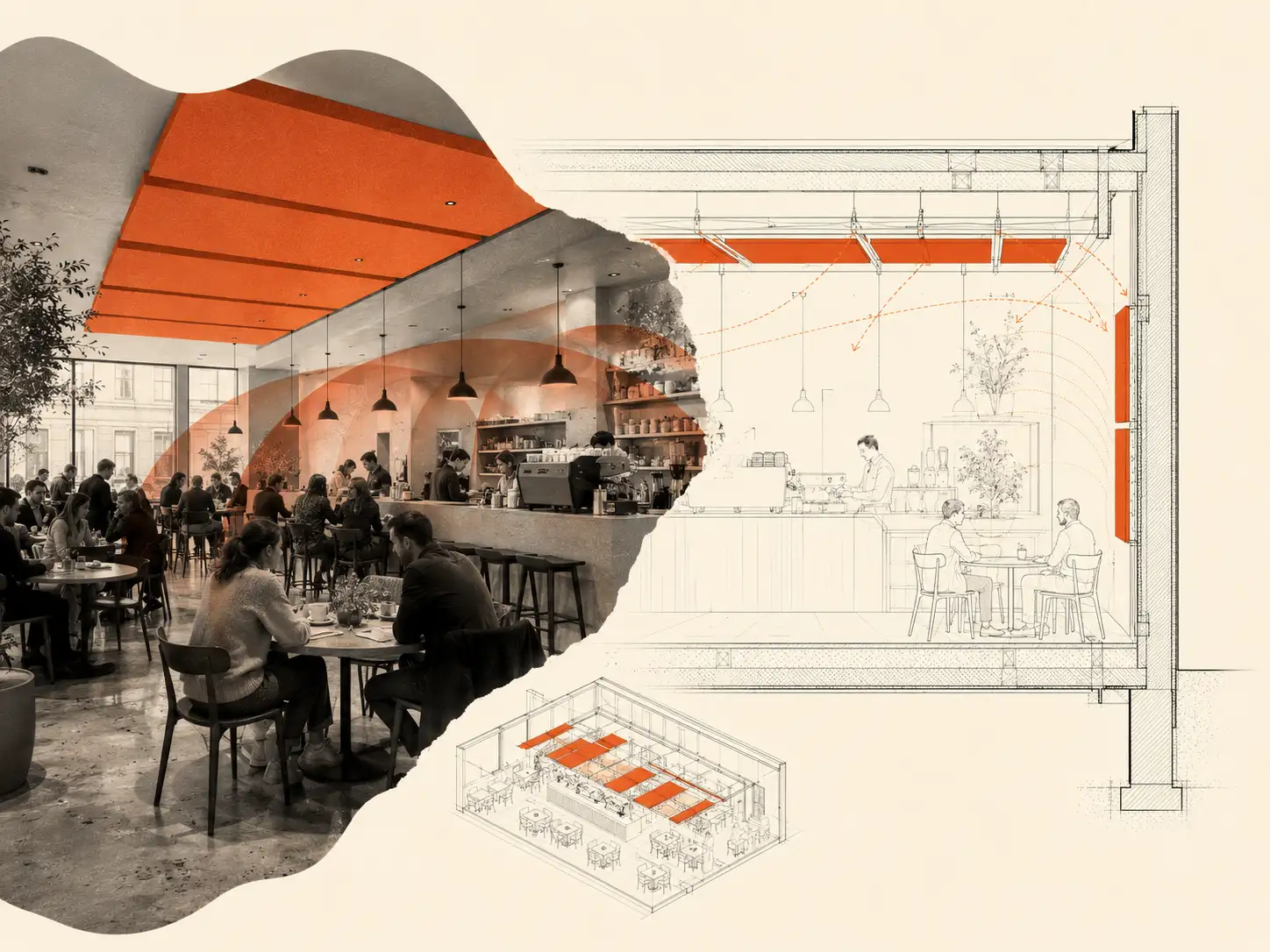
Start with the ceiling. In most meeting rooms, the ceiling is the largest untreated reflective surface and the one that returns the most speech energy back down to the table. A ceiling-mounted absorber, sometimes called a cloud, directly above the main seating area can reduce the reverberant decay significantly. It absorbs the upward-travelling speech energy before it can bounce back and interfere with the next syllable. The improvement is immediately audible: voices sound closer, clearer, and more distinct.
Address the first reflection points on the walls. The surfaces directly to the sides and behind the speakers, wherever sound bounces most directly back toward the listeners, are the highest-value wall treatment positions. Even modest absorption at these points reduces the early reflections that cause the most intelligibility damage. In a glass-walled room, this might mean a fabric-wrapped panel on the one solid wall, or an absorptive element integrated into existing shelving or display surfaces.
Consider the table. Large, hard meeting tables are surprisingly effective reflectors of mid- and high-frequency sound. The voice hits the table surface and bounces up toward the ceiling (which bounces it back down again). In rooms where the table can't change, ceiling treatment becomes even more important. It breaks that vertical bounce path.
Look at the conferencing setup. Once the room's acoustic behaviour is improved, the conferencing system immediately performs better because the microphone is picking up a cleaner signal. In many cases, rooms that were considering expensive AV upgrades find that basic acoustic treatment solves the problem the new hardware was supposed to fix. At a fraction of the cost.
The total intervention for a typical 20-to-30-square-metre meeting room might be a ceiling cloud, two or three wall panels, and possibly some adjustment to existing soft furnishings. It doesn't look like a studio. It doesn't look like a compromise. In a well-specified treatment, it looks like someone thought about the room properly, which is exactly what happened.
How to think about the cost
We find it helps to frame this against the actual cost of the problem, which is invisible but real.
A meeting room used by eight people for two hours a day represents roughly sixteen person-hours of daily productivity tied to that room. If acoustic fatigue reduces effective concentration by even 15 or 20 percent, and research on speech intelligibility and cognitive load suggests this is conservative for untreated reflective rooms, that's two to three person-hours of diminished quality every day. Across a working year, that's hundreds of hours of meetings where people are working harder than they need to just to hear each other.
Treatment for a room like that might cost a few thousand euros. The productivity drag it removes was already costing more than that every quarter. Nobody wrote a line item for it because it doesn't show up on a spreadsheet. It shows up as "that room nobody wants to book for the afternoon slot."
What this makes possible
A treated meeting room doesn't just sound better. It changes how people behave in it.
Conversations become more natural because people don't have to project or repeat. Hybrid calls improve because the microphone picks up clean speech instead of room reflections. Meetings run shorter because less time is spent on miscommunication and repetition. And the low-grade fatigue (the thing you noticed first, the reason you're reading this) goes away. People walk out of the room feeling like the meeting took exactly as much energy as the content deserved. No more, no less.
That's what a well-behaved room does. It gets out of the way. It lets the conversation be the conversation instead of a fight with the acoustics.
You noticed the problem. That's the hardest part. The rest is just surfaces, placement, and a room that finally works the way it looks like it should.